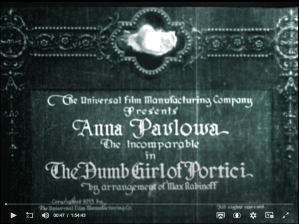
Anna Pavlova the Incomparable! Thus is the ballerina introduced on the opening title card of the 1916 silent film The Dumb Girl of Portici. The film is significant: Not only is it Pavlova’s only feature-length movie, it was the first cinematic epic directed by a woman, Lois Weber. In an occupation largely viewed, even today, as a masculine domain, Weber was, by 1917, as quoted by Anthony Slide in his book Early Women Directors, acclaimed (though in gendered terms) as the “screen’s greatest woman director,” making “some of the most interesting and notable productions” of the early silent era. Her reputation and surviving works have fortunately been rediscovered and re-celebrated in the 21st century, and she is now recognized as a feminist and cinematic icon.
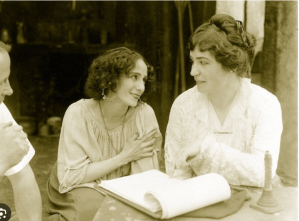
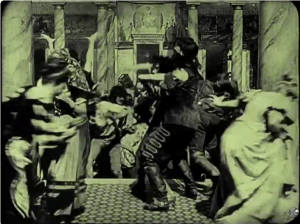
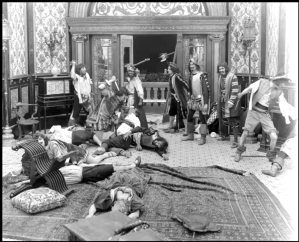
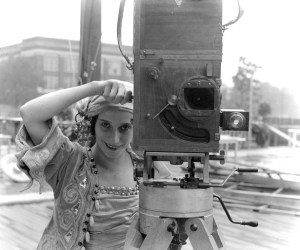
Weber’s work should be recognized. Based on this film, she had an eye for arresting compositions, knowing where to place her camera to highlight action and dramatize screen space in depth. And she knew how to move her camera: Note in the film’s insurrection scenes, as peasants surge the aristocrats’ palace, how the camera’s panning from side to side, then pulling back and back through scenes of hand-to-hand combat, convey their violence and carnage, the crush and rush of bodies overwhelming the film frame. Yet Weber always maintains clarity and focus despite the chaos enacted onscreen. You always know where the action is placed and what’s being done—your eye is filled with its spectacle while your mind is caught up in its drama.
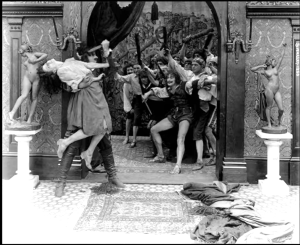
But the movement I’m concerned about in this film is Anna Pavlova’s.
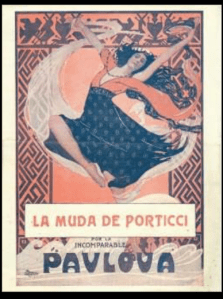
Some background first: The Dumb [meaning Mute] Girl of Portici began as an 1828 French opera, La muette de Portici, music composed by Daniel Auber. The libretto, by Eugène Scribe, loosely dramatizes the 1647 Neapolitan uprising against the Spanish throne, its (historically based) fisherman-hero, Masaniello, leading a revolt against oppressive Spanish rule. Per the Wikipedia article, one opera performance inspired an actual revolt, the Belgian Revolution of 1830. Composed during revolutionary times, the opera was also something of a revolution, said to be the earliest example of the ‘Grand Opera’ style, its musical structure and ensemble form influencing the young, revolutionary Richard Wagner.
As for the Mute Girl, she is Fenella, Masaniello’s sister, who, during the opera’s opening wedding of the Spanish Viceroy’s son, reveals, through mime, that she had earlier been seduced and abandoned by him, an event that ultimately triggers the rebellion. The role was originally created on the Paris Opéra dancer Lise Noblet; other dancers in the role have included Marie Taglioni, Fanny Elssler, and Pauline Leroux—almost a who’s who of early 19th-century Paris Opéra ballerinas. Indeed, according to Ivor Guest in The Romantic Ballet in Paris, Scribe’s idea was to create a mimed role for a ballerina to compensate for a lack of major soprano talent. La muette, says Guest, “quickly became one of [the Opéra’s] most popular works,” despite critical reservations about its non-singing title heroine, one critic remarking on “the incongruity of one character expressing herself in one medium while the rest did so in another.”
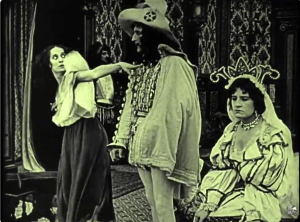
A corresponding incongruity is also in the 1916 film, in that all the singing characters are as silent as the Mute Girl. Weber’s adaptation, however, works around it, not only by substituting singing with florid acting, but also by foregrounding Fenella’s story. Her seduction and betrayal by the aristocratic Alphonse, offstage in the opera, are now dramatized through much of the film’s first half; and her movie death is also more gallant than her operatic one: Instead of leaping into volcanic lava (Vesuvius happens to erupt during Auber’s finale!), she dies protecting her faithless lover. The movie centers not on a rebellion featuring a silent title character, but rather on a tragic Romantic heroine, with a revolution on the side. Fenella here becomes the story’s emotional and dramatic core—of innocence betrayed and sacrifice rewarded, with the movie’s final scene lifting her towards a kind of heavenly apotheosis. A work in the 19th-century grand opera tradition becomes a 20th-century cinematic star vehicle.
And that vehicle’s Star is Anna Pavlova.
Per Keith Money’s monumental biography of the ballerina, Pavlova’s decision, in 1915, to make the film was spurred by another enterprise, her agreeing to invest $75,000 in a joint dance/opera partnership with the Boston Opera Company. Needing the investment money, the ballerina agreed to sign with the then-Universal Film Manufacturing Company (later Universal Pictures), stating in a newspaper interview that Fenella was a role she always wanted to perform as it “’offered great opportunities for pantomimic work.’” The film was budgeted at a then-whopping $250,000 (over $8 million in 2026 dollars), not including the dancer’s salary; and its film schedule was split between Chicago and Los Angeles to accommodate Pavlova’s touring dates. That Universal agreed to this request, says Money, ”was a sign of just how much faith they placed in the drawing power of their new star.” Of added note is that Universal was the first Hollywood studio to promote stars in its marketing; hence Pavlova’s hiring further centered her star status, and appeal, in this film.
Weber also acknowledges Pavlova’s star power; the film’s (very) few close-ups are almost all of her—showcasing her character’s passion, joy, artlessness, and grief. Fennella’s characterization is your stereotypically Innocent Peasant, replete with an Of-the-People Life Force; she literally skips and bounds when she moves, smiling and laughing at the world, then falling madly in love and just as madly getting her heart broken. Plus, she suffers—she’s rejected by her lover, menaced by a lustful fellow peasant, condemned by the Viceroy, thrown into a rat-filled prison and flogged, and used by her brother for his revolutionary cause; finally, she throws herself in front of her worthless swain to receive the blade meant for him. Star-vehicle material, indeed.
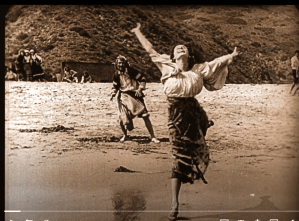
But Pavlova is wonderful in the role—ardent, changeable, quicksilver in expression, flowing from laughter to tears to silent anguish with a grace as fluid as her dancing. She flings, I mean literally flings, herself into motion—running across a beach, she leaps into arabesque, arms shooting up, breastbone lifted, poised like a butterfly, the very air seeming to hold her. She infuses all her motions with speed, drama, and a bold, unconstrained energy; and the way she’ll throw herself into a pose slightly off-center reminded me of Farrell—that kind of hurl-against-gravity defiance, of daring herself to stay upright, and daring us to watch.
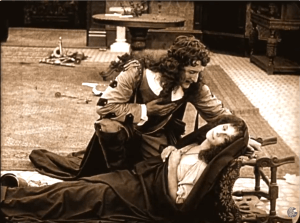
Pavlova doesn’t do much actual dancing as Fenella—it’s more the Happy-Sad-And-Feelings-In-Between mimed acting of silent film—but she brings psychological subtlety to her role; receiving a message from her princely lover, she assumes a regal air, ordering the messenger to open the (curtained) door for her. Per Money, Pavlova learned during filming how to act “close to a camera”; “Before long,” he writes, “her acting was quite as compelling as that of any experienced movie actor.” But it’s more than Pavlova’s acting. Everything she does onscreen is imbued with her unique physical and emotional fluency, what a contemporary reviewer described as her “’strange personality and extraordinary grace…She would be quite lost in a story of so-called modern realism.’” Such fey qualities are seen in a closeup of Pavlova when Fenella is first embraced by Alphonse: Her features dissolve from innocent joy into an awakened sensuality; sinking into her lover’s embrace, she falls back in his arms as if in ecstatic death. The moment is strange, yet genuinely erotic—as if Alphonse has caught the Sylphide herself in passionate clasp.
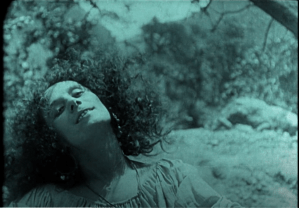
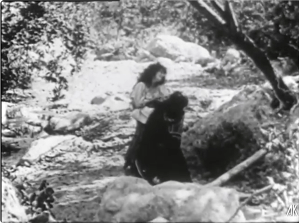
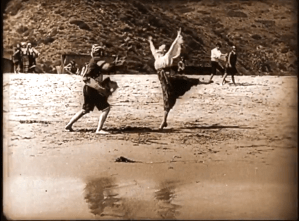
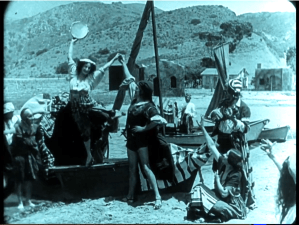
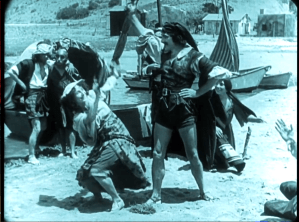
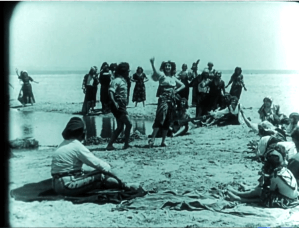
As noted, Pavlova doesn’t dance much within the story proper. Weber, Money writes, “conscious of the great risk she was taking in denying audiences a view of Pavlova the dancer,…devised three interludes, in the manner of ‘visions,’ with Pavlova drifting around on pointe.” One of these interludes does occur within the plot, of Fenella performing a brief (un-visionary) tarantella for her friends. Invited to dance, Fenella springs up in arabesque, flinging her arms to the sky; then, leaping to the sand, she spins, twists, and dips into a curved bend, arms twining above her head. Sprinting onto the beach, she jumps, skips, and turns, slapping her tambourine and freely tossing out arms, torso, and legs (note Weber’s composition here, how the watching actors are naturally placed to frame Pavlova). Her dance is simple—Fenella prances, poses, throws back her shoulders and thrusts out her pelvis, an arm raised to beckon her friends. The number may be in a simulated ‘folk’ style, but even within such artifice, Pavlova moves like a wild, lyrical being, dancing with the unself-consciousness of a young faun.
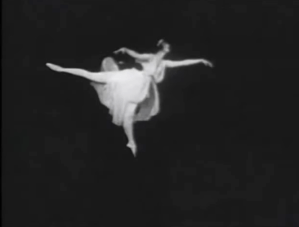
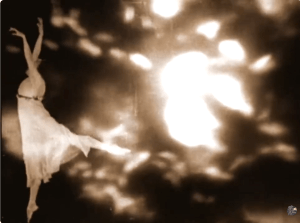
Weber places Pavlova’s two ‘visionary’ dances at the film’s start and end, like a prologue and epilogue bookending its story. The first, pre-story dance has no connection to the film’s plot; it seems meant as a presentation of Pavlova alone, a display of her exquisite line and feet, her liquid arms (was she influenced in such by Isadora Duncan?), and her dreamy, drifting expression. What’s unusual about this dance is its use of an invisible partner, clothed all in black against a black backdrop: Pavlova seemingly floats through air or hovers weightlessly in space; bourréeing swiftly on pointe, she fades into darkness as the background absorbs her. Her dance lacks technical or choreographic complexity (I assume she devised it herself). But it’s arresting to watch—you sense, as well as see, her movement impulse, the energy and flow through her torso; posed in arabesque, she unfolds like a flower opening its petals. As Lexa Armstrong notes of the dancer, “[h]er technique was unbound from the strictest sense of a codified vocabulary, but still adhered to traditional balletic qualities of weightlessness and grace.”
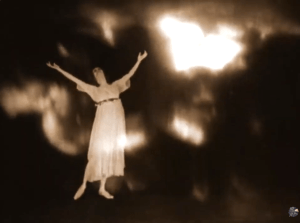
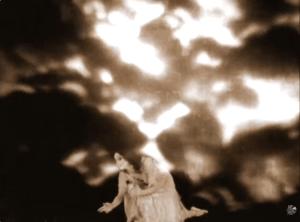
Pavlova’s final dance, occurring right after the story’s finish (with Fenella and her brother dead and the revolution failed), does seem linked to its plot, in that it appears to represent Fenella’s assumption into Heaven. Dressed in a similarly loose, Grecian-style gown as in her first dance, and superimposed before a shifting cloudscape, Pavlova again endlessly bourrées, skimming the ground with ethereal grace, in what seems almost a meditation on the passage from death to the afterlife. The dance is again simple: Pavlova wafts back and forth across the screen, lifting on each side into a gorgeous arabesque (note how she completes the movement with a delicate stretch and flow of fingers, hands, and wrists). Gliding across the frame, she extends her arms heavenwards, as if yearning to reach the empyrean. Then she spins round and round, immersed in her motion, circling through space and time like petals revolving in the wind.
—Scroll to the 2:14 mark in the video below to see Pavlova’s final dance; further scroll to the 5:40 mark to see her peasant tarantella dance; then scroll to the 8:13 mark for the complete scene of Fenella’s embrace by Alphonse:
One other aspect of The Dumb Girl of Portici makes it noteworthy for me. As Money notes, the film’s love plot tends towards “the best Giselle-like traditions of blighted love”; he further writes that, once filming was completed, Pavlova and her dance company joined the Boston Opera enterprise to again perform—La muette de Portici, the ballerina recreating Fenella for the operatic stage. Her opera performance, says Money, featured an “intensity of characterization that [had] chilled [audiences] when it took form as Giselle.”
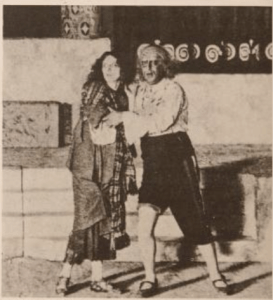
Gisellian similarities are certainly present in the opera: We have a joyful, innocent girl, with an infirmity (a weak heart in Giselle; muteness in Dumb Girl), who’s a beloved member of a peasant community (Rhenish in Giselle, Neapolitan in Dumb Girl), who gives her heart to a disguised aristocratic scoundrel (Albrecht in Giselle, Alphonse in Dumb Girl) with an aristocrat fiancée in tow (Bathilde in Giselle, Elvira in Dumb Girl), and who goes mad when she learns the truth. The similarity is heightened by Weber’s changed ending, of Fenella sacrificing herself for her lover as an act of forgiveness. You might say Dumb Girl is Giselle with politics: Instead of Myrtha we get a nefarious Viceroy; instead of the Wilis we get an insurrection. In either case, the finale has the heroine ascending towards a peace beyond death, while her lover is left behind to repent.
All of which makes me wonder: Might Pavlova’s performance in this film bear traces, however slight, of her legendary Giselle—at least her Giselle of Act One?
Pavlova is considered one of the greatest Giselles (in his 1982 documentary A Portrait of Giselle, Anton Dolin described her as “a very great dancer” in the role). She first performed the ballet in St. Petersburg in 1903, Petipa choosing and coaching her specifically (Money speculates if Petipa may have “rebuilt the role” around her); and she performed the ballet throughout her career, frequently with her own company/ies. Yet, beyond some photographs and critical reviews, no one can say how she performed; no film exists of her in this role. It’s only my own speculation but I do wonder—could Pavolva have been drawing on her Act One Giselle for such similar scenes in Dumb Girl? Can her balletic interpretation be inferred, like a pentimento beneath a painting, through analogous moments in the film?
I’m not claiming for Pavlova’s film performance a deep Giselle imprint—it’s more a hint, a whisper, a faint impression of what her Act One balletic peasant girl might have been like. Money writes that Giselle was important to Pavlova, noting “[s]he was to cling to this role throughout her life.” And no doubt Pavlova would have noticed Dumb Girl’s similarities to Giselle; or, if not its plot parallels, at least its continuity of style and theme—its archetypal Wronged Heroine, whose innocent, wholehearted love is betrayed by a heartless (or maybe deceived) lover with a short attention span. Ballet (as well as opera) is filled with such doomed ladies, as seen in such works as La Bayadère, Swan Lake, and Ashton’s Ondine; even a work like Balanchine’s more abstract Serenade, which, though not presenting an explicit story, does suggest in its choreographic structure a similar arc of suffering, sorrow, and loss.
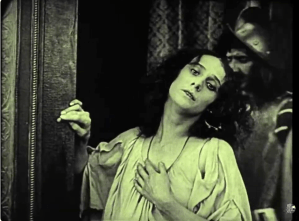
And there are tiny sparks in the film—such as when Pavlova, surprised by Alphonse, becomes suddenly still, her eyes and face entranced; it recalls, for me, those early first-act moments when Giselle first meets Albrecht—the hesitation, the stillness, the shy gaze of adoration—and for one fleet instant I felt it visible, present, there. I felt it also in the scene when Fenella discovers her lover is bethrothed: Her face slackens, her eyes go blank, as, staggering back, she presses a hand against her chest as if in pain—right before, perhaps, the mind breaks and reality crumbles. In such scenes I found myself watching Pavlova so intensely—so caught up in the notion I might be witnessing, however vestigially, another peasant girl from another 19th-century story. Afterwards I was exhausted—from trying, I realized, to absorb as much of Pavlova as I could. Watching her in these scenes, attempting to imagine an unseen, lost history, through such inadequate documents—a look, a gesture, a fleeting glance—imperfectly printed on century-old nitrate stock…felt as elusive as attempting to capture the Sylph.
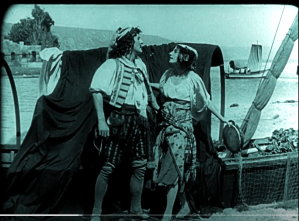
—Fenella’s surprised encounter with Alphonse (note Pavlova’s expression at the 24-second mark):
After Dumb Girl, Pavlova was never to make another feature-length movie. The films we most frequently associate with her now are the short ones of her famous solos she shot in the mid-1920s at Pickfair (home of Mary Pickford and Douglas Fairbanks). Her main interest in Dumb Girl, says Money, was financial (she held a half-interest in its profits) as well as it being a possible means of increasing her market value for the stage; she was not, Money adds, interested in becoming a film star.
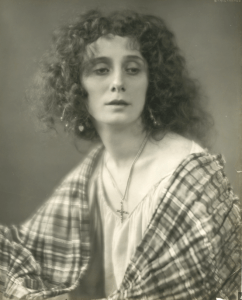
But what if she had continued acting in dramatic roles, in feature films? To my eyes, Pavlova’s face seems made for cinema, and for the camera’s probing eye: She possessed the most exquisite bone structure around jawline and breastbone, set above a long, swan-like neck, strong yet delicate. Her arms and hands are similarly strong but expressive, their modeling incised along her musculature; and her eyes are dramatic—capable of conveying shades of feelings ‘in the moment,’ as actors say, to express her soul. One detracting factor might have been Pavlova’s age. She was about 35 years old when she made Dumb Girl; while still at her onstage peak, on film…then, as now, youth and unlined features were prized, especially in the early silent era, when film lighting was especially harsh and revealing. Money notes when Dumb Girl opened, some critics mentioned “that Pavlova did not possess a conventionally pretty ‘screen’ face.” How Pavlova might have fared in future films is anybody’s guess; her greatness may have been too potent, too singular, too…ineffable, to be captured fully on celluloid.
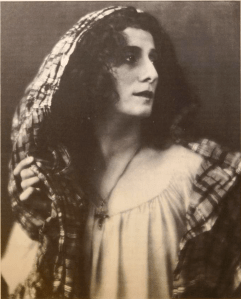
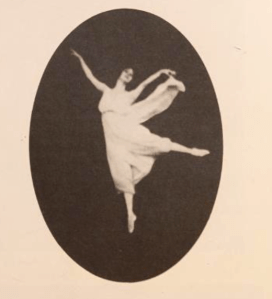
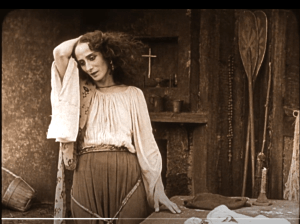
Yet, as Money writes, Pavlova “had the power to project—the one quality that could be encouraged but never entirely taught.” Just watching her stand at a window and raise one arm towards the sun, I felt my heart melting at the simplicity and eloquence of her gesture. And her onscreen image is haunting: With her dark hair and eyes, her pale skin, her limpid movements and slender frame, she seems fragile and a little unreal, as if she’s already halfway to ghost-hood—strange yet graceful, as that reviewer had noted. If nothing else, Dumb Girl gives us a portrait of an artist at her height, in a complex, fascinating role that encapsulates as much of her physical, emotional, and dramatic genius as possible in a two-dimensional medium.
And, most vividly—we grasp here her spiritual quality. As Money writes: “Pavolva put some element of her soul into each of her roles; they were her life.” We see it in the film’s final dance, of Pavlova’s celestial ascent through cloudy skies (could this be another Giselle-like hint—of the dancer’s legendary lightness, what Money describes as “a spectral physical grace that was almost disturbing in its singularity”?). Pavlova bourrées onscreen with a tender grace, rising into her inimitable arabesque—no one had a line more beautiful than hers—and stretching out her arms, as if to embrace the heavenly space around her. Her dance is simple, slow, not technically demanding, but oh so eloquent—does anyone possess such expressiveness today? You see why Pavlova was special, why she stood out. She moved, like no one else ever could; and in her movement, she embodied an entire, impalpable, yearned-for world. In the film’s last image, she drops to one knee to gesture below her, as if to bless our own world that she leaves behind. Then she rises once more to dance, as she vanishes before our eyes. Incomparable.
Click here to watch The Dumb Girl of Portici free on the Internet Archive, in an excellent restored and tinted Library of Congress print with a musical score. It can also be purchased on DVD/Blu-ray from Kino Lorber.
Here’s the modern trailer for the 2016 release of the restored version of The Dumb Girl of Portici:
Below is a YouTube short, courtesy of From Pit to Stage, that gives a compressed but detailed history of Anna Pavlova and the making of The Dumb Girl of Portici:
 Utter Dances