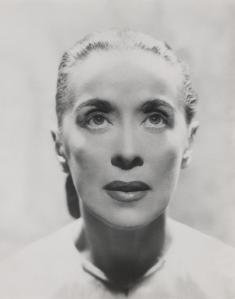
The New York Public Library for the Performing Arts is currently presenting the exhibition Martha Graham: The Mother of Psychological Dance, in its Oenslager Gallery, in celebration of the 100th anniversary of The Martha Graham Dance Company, founded in 1926. I’ve attended three times so far, including a guided tour; the show is small enough, and basic enough, to serve as a good introduction to those not familiar with Graham’s genius and her work; yet it’s comprehensive enough in the information, examples, and analyses provided of her art and oeuvre, to satisfy the knowledgeable. Below is an excellent summary, courtesy of The Dance Lens YouTube Channel, of what the exhibition presents and how it is presented:
Martha Graham wasn’t the first 20th-century dancer in the West to break away from the formalism, artifice, and perceived restrictions of the then-dominant professional dance form (aside from popular dance in vaudeville and the musical stage) of classical ballet. Isadora Duncan, Loie Fuller, Grete Wiesenthal, and Ruth St. Denis (Graham’s first teacher), among others, had preceeded her. She wasn’t even the first to utilize severe, dramatic expressionism in her choreography; that would be Mary Wigman, whose stark, stripped-down dances—often choregraphed to the sounds of drums or gongs, or to no sound at all—made her the darling of the intellectuals.
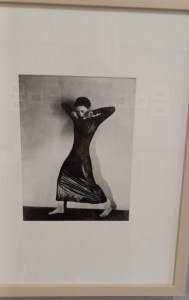
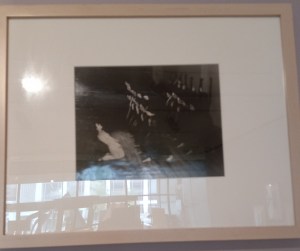
But among what Graham did was to create a vital, encompassing, and intense technique, based on the rhythm of the breath, as expressed in contraction and release, and centered in the pelvis. Used in her choreography, and transmuted through the dancing body, it reveals profound psychological insights into character, emotion, and artistic creation. Lincoln Kirstein famously disliked modern dance (although he initially liked Graham) because, as he saw it, it was based on individual choreographers; unlike balletic classicism, formulated on a 300+-year-old movement syllabus, modern dance is ‘personal,’ therefore ephemeral. Graham’s movement vocabularly, however, has been codified and, 100 years on, is still taught and extensively used. As Agnes de Mille recalled in a conversation with Glen Tetley, countless dancers and choreographers have ‘stolen’ from it: “Everyone who had taken classes with Martha,” de Mille writes, “had gone away and taught her exercises and style. One might as well try to stop a principle in chemistry, or mathematics, or medicine.” Graham flourishes, in part, because her methodology does. From her first, modest recital in April 1926 (consisting of just the choreographer and three female disciples), there began, says one of her biographers, Don McDonagh, a revolution that “changed the course of dance in the twentieth century.” And that continues today.
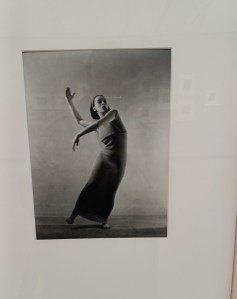
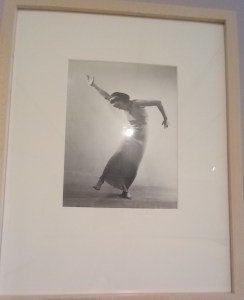
It’s this revolution in technique, training, movement, and choreography on which the NYPL exhibition focuses. As indicated in the Dance Lens video, the exhibition comprises photographs, video clips, original documents, costumes, stage props, and explanatory text, written by the exhibition’s curator, Jack Ferver, in five sections, or ‘acts.’ The first, titled ‘The Divine Feminine,’ looks at what could be called Graham’s radical feminism of the era. As both dancer and dance creator, Graham’s work defiantly broke away from the superficial decorativism and ‘prettiness’ of women in classical ballet. Instead, working for the first twelve years of her company’s existence with all-female ensembles, Graham chose to present women as strong, empowered, grounded beings, who, notes Ferver’s text, are the “sites of authorship and meaning.” In the silent clip below (excerpts from Chronicle, 1936, and class demonstrations), the women, as they jump in a line or turn in circles, move with force, energy, and precision; they seem to impress themselves upon the very air through which they move—their bodies like pillars or trees, their power at one with the gods. This, as Ferver notes, “was revolutionary.”
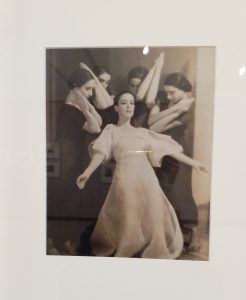
Act Two is ‘America,’ examining (Mayflower descendant) Graham’s interest in, and focus on American themes—whether it’s the harsh, rejecting Puritanism of Heretic and American Provincials, the wide open spaces envisioned in Frontier and Appalachian Spring, or contemporary issues of social unrest and change, as presented in the anti-war Chronicle—particularly the “Steps in the Streets” section (below), whose repetitive, percussive choreography, performed by a black-clad female ensemble, suggests rebellion, despair, and oppression—and especially in American Document, which Graham created in response to the rise of 1930s European Fascism (when she and her company refused to perform at the 1936 Berlin Olympics). This latter piece included, for the first time in Graham’s work, spoken text, with excerpts from the Declaration of Independence and the Emancipation Proclamation, among others; later, revised versions would expand to include writings from John F. Kennedy and Martin Luther King, Jr. This section examines Graham not only as a dance pioneer but as a social revolutionary—her company was the first to integrate racial minorities, with dancers such as Yuriko and Mary Hinkson—and as a cultural commenter, responding to her era’s political crises with activist ballets.
Act Three, ‘Grief and Joy,’ examines Graham’s somatic exploration of contraction and release, which became, as she noted, “the dramatization in body form of the process of breath.” Here the emphasis is on how the involuntary and interdependent responses of crying and laughing will pull in and then release emotional utterance through the body. Graham used this technique, as Ferver notes, as a means of pushing audiences past their comfort zones; she didn’t want them to be passive viewers but active, conscious recipients. Highlighted in this section is Graham’s famous 1930 solo, Lamentation (below, featuring Graham herself), in which, seated on a low bench and wrapped in a long tube of jersey cloth that hides most of her body, Graham articulates the dance’s meaning through the simplest of moves—extending her arms, upper torso, and legs to bend, slant, and stretch the cloth, rocking and straining within its confines as if to defy, yet submit to its limits. It’s by such simple gestures that the dance embodies, in visceral form, an all-encompassing grief.
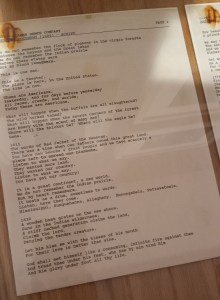
In Act Four, ‘Psychosexual,’ there’s both a change and a distillation in Graham’s choreography. The change was Martha introduction, in 1938, of male dancers into her company; the distilling was in her zeroing in on the themes that had preoccupied her throughout her career—Myth (particularly Greek), Archetypes, and Dreamwork (via her relationship with the Jungian analyst Frances Wickes). The inclusion of men was no doubt sparked by the start of her long relationship, both artistic and personal, with the dancer Erick Hawkins; it’s no great leap to see, in ballets such as Night Journey (Jocasta and Oedipus), Phaedre, Cave of the Heart (Medea and Jason), Errand Into The Maze (Ariadne and the Minotaur), and the evening-length Clytemnestra, a formalization, per Ferver, “of eros into movement.” Because Graham’s technique centered on the pelvis, her choreography explicitly delineated eroticism and sexual passion, “demonstrating,” says Ferver, “where and how desire itself can be the driving force of choreography.” Graham stated this principle in her annotations on Night Journey (below), in which Jocasta’s slow, anguished développé enacts what Graham called “the “vaginal cry.” We see it also in Medea’s famous solo in Cave of the Heart (below), in which the betrayed Medea’s rage, heartbreak, and despair seemingly batters her body from within, as if to shatter her into pieces. Skittering sideways on her knees, she pulls from her costume the symbolic red rope of her inner life (her entrails, as it were) and gnaws on it in a bitter statement of revenge. Watching it, I always feel my own breath pull in, shake, and twist me, in a shared feeling of pity and terror.
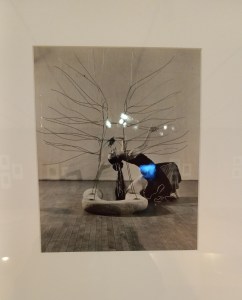
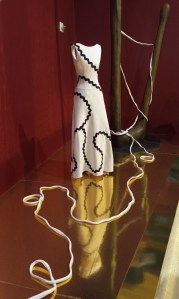
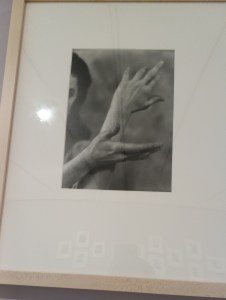
Act Five, ‘Technique,’ looks at Graham’s revolutionary dance technique, per se; but it also explores her influence, her teaching, and her legacy. As such, it goes beyond her specific art and work to present her as a dance and cultural icon. Her influence extends not only to dancers and choreographers but also to actors (Bette Davis was a pupil), psychologists, historians, writers, and artists in all fields. The Graham technique is a unique and evolving dance alphabet, a consistent language of dance, that trains and extends the dancer to express, in corporeal form, the deepest truths of our human existence; it renders the artist, Ferver notes, into an “integrated instrument of body and mind.” As Graham herself notes (below), her technique, distilled into dance, exemplifies “the magical first equipment of a dancer—the lovely straight back and the pliable body,” which is, she concludes, “like an exclamation point.” Significantly, the last wall, and endpoint, in the exhibition’s space displays photographs of Martha’s company members in stills from her ballets. The legacy, the art, and the dancers, we are reminded, go on.
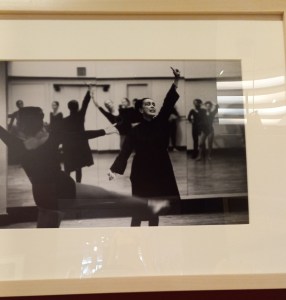
The exhibition’s trajectory is not merely chronological but thematic; within that structure it traces the evolution of Martha’s artistry, her continuing concerns and obsessions, and how she enlarged the field and art of modern dance. Focused as it is on the 100 years of Graham and her company, the exhibition does omit the choreographer’s early life, training, and work (not included, for example, are Graham’s years with Denishawn). Yet in its concentrated space the exhibition gives a concrete sense of who Martha Graham is as artist and dancer, and how her art reflected not only dance and choreography, but the 20th century—her place in it as well as her contributions to its artistic landscape. That is the exhibition’s major achievement: It lets us see, so clearly (as, no doubt, Martha would want us to), the volume of Graham’s work, the extent of her vision, the scope of her art. It’s a tribute to what Martha and her company strove for, accomplished, and willed into being for the past 100 years. May there be 100 more.
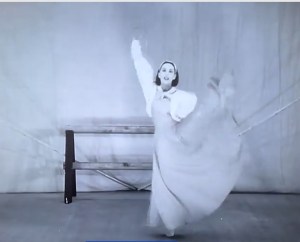
Martha Graham: The Mother of Psychological Dance is on view free of charge at the New York Public Library for the Performing Arts through November 7, 2026. Click the link here for more information on the exhibition, guided tours, and other materials and resources.
Video clips are courtesy of the Martha Graham Dance Company YouTube channel (and are not necessarily part of this exhibition). Photographs shown were taken by me at the exhibition (original photographs by Barbara Morgan and Soichi Sunami).

