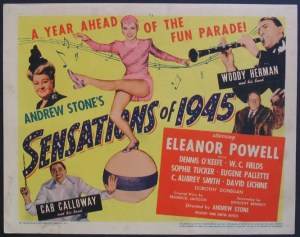
Gems can pop up in the most unpromising settings. Such as this Eleanor Powell-David Lichine duet in an independently produced film titled (misleadingly) Sensations of 1945. Released in 1944, the film was produced, directed, and part-written by Andrew Stone, made by Astor Pictures, and released through United Artists. And while the movie is barely worth watching, this dance routine (courtesy of the terrific John Hall YouTube channel) is.
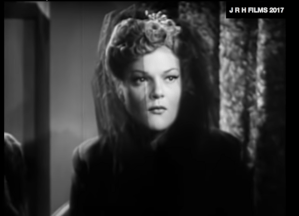
As an aside, if you’re wondering who that Woman in Black with a Gun is: The film’s slight plot concerns a dancer (Powell) and a press agent (Dennis O’Keefe) engaged in rival publicity stunts to promote a series of vaudeville acts, the so-called Sensations. The first such stunt (spoiler) has Powell’s disguised assistant sitting in a theater box during Powell’s dance number, and then, from that box…shooting at Powell onstage. Being the bullets are blanks, Powell’s in no danger; the whole thing is to garner press attention. What makes this device so annoying, aside from its silliness, is how the camera keeps cutting back to that pistol-packing dame, draped in heavy Victorian mourning (at a theater? Really?) and garnished with flared eyelashes out of Cruella De Vil. I suppose it’s to create suspense, but all I could think was—I’d rather watch the dance.
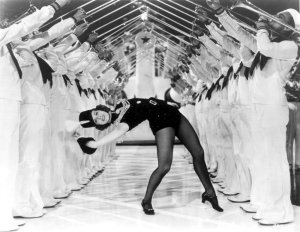
Sensations came about, per Paula Broussard and Lisa Royère’s 2023 biography Eleanor Powell: Born to Dance, after Powell had left MGM, the studio that had made her a star. Or had MGM left her? Powell had been a MGM box office champ since her first film there, Broadway Melody of 1936. Throughout the 1930s her elaborate, dazzling tap-dance extravaganzas were huge studio moneymakers (Ann Miller claimed Eleanor was so popular, she saved MGM from bankruptcy). It didn’t hurt that tap dancing was then also an American sensation, with Eleanor entering movies as the form was peaking. Both Powell and MGM crested on tap’s boom, probably hitting their own joint peak with her famous 1940 “Begin the Beguine” number with Fred Astaire.
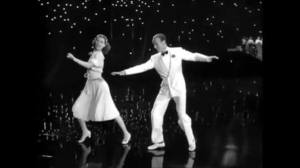
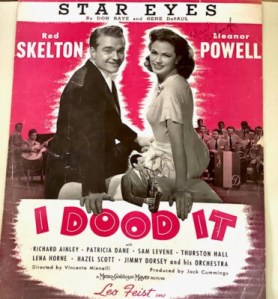
Nothing lasts, however—certainly not movie stardom. By the early 1940s, though still a top-billed performer, Eleanor’s box-office draw was dimming. Broussard and Royère point to MGM producer Arthur Freed’s decision to focus on younger stars after he “categorized [Eleanor] as belonging to an old style of musicals.” In her 1942 film Ship Ahoy (featuring her brilliant tap routine “Tallulah,” which I wrote about here), Eleanor shares equal time, and billing, with up-and-coming comic Red Skelton; in their second film, 1943’s I Dood It, she’s pretty much his second banana. (This later film, per her bio, was “one of the tipping factors in [Powell’s] decision to leave the studio.”) It’s a classic studio ploy—pairing a rising star with an established or even fading one, Skelton ascending to stardom on the taps of Eleanor’s heels, as it were.
But also contributing to Powell’s fading box office was the decline of tap itself. The 1943 stage success of Oklahoma!, and its new, more expressive dance style, “played a significant part,” her biographers note, “in dethroning tap from its prominent place in musicals, giving way to jazz dance. MGM no longer saw bankability in vehicles built around a strong solo female tapper…Eleanor was the last of her class.” Though only in her early thirties, Powell was deemed out of date, although “iconic male dancers such as Astaire and Kelly retained their star status and were permitted to age on screen with grace”—while also changing their dance styles away from tap. In May 1943 Powell requested and was granted early release from her MGM contract. After marrying Glenn Ford, with whom she was romantically involved, she accepted another film offer.
That came from Andrew Stone, who, say Broussard and Royère, thought Eleanor “’had not been done right by’ MGM” (I’d say he was right) and offered her the lead in Sensations of 1945. Eleanor claimed to like Stone and his ideas “’which jibe with mine about shooting dance numbers’” (presumably allowing Eleanor independence in creating her routines). Although Stone’s (very) low-budget film was, note her biographers, “a far cry from Eleanor’s high-budget MGM productions…it allowed her the opportunity to display her acting and comedic ability.” Stone also brought in the noted Ballet Russes dancer and choreographer David Lichine to stage the ‘jitterbug’ dance that opens the film; and Eleanor “began training with Lichine and was soon back to her former routine of six-hour daily rehearsals.”
Lichine was an interesting choice: Like Eleanor, he was classically trained; unlike Eleanor, he was born in Russia and balletically schooled in Paris (by Lubov Egorova and Bronislava Nijinska). Beginning in the early 1930s, Lichine was dancing and choreographing for such companies as de Basil’s Ballets Russes and the then-new Ballet Theatre, among many others; by the early 1940s he was working in Hollywood, as well as staging theatrical musicals and even directing plays. Katherine Sorley Walker describes Lichine as “[a] demi-caractère dancer rather than a pure classicist…[with] a captivating theatre personality, good looks, and an abundance of charm and spirit”—qualities certainly evident in the clip above—as well as “a choreographer of great ability, in many ways working ahead of his time”—which I’ll argue is also evident in this dance for Eleanor and himself.
For Powell, Sensations turned out to be a one-off, and it’s not hard to see why. It’s a dreary comedown after her MGM glitz: Its novelty acts (presenting some well-known performers—W.C. Fields, Cab Calloway, Sophie Tucker, not at their best) include such offbeat oddities as a bouncing tightrope walker, some acrobats, two performing bears, and a row of dancers prancing on pointe. A routine with Powell and a dancing horse named Starless Night is unpleasant to watch; the poor beast looks terrified and was, per Powell’s bio, not easy to work with (it took 80 takes to get a print, which seems more like an exercise in animal cruelty). And I have to disagree with the biographers’ idea of Powell displaying her acting and comedy skills. As the critic David Shipman remarked about Cyd Charisse and Powell—watching them act onscreen you have to keep reminding yourself what good dancers they are.
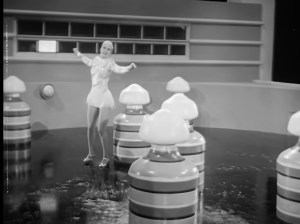
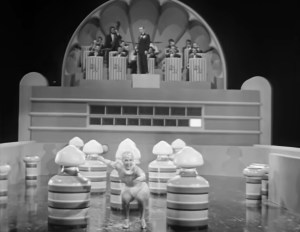
Powell was certainly that. Her astounding tap skills are on display in her one solo number in the film, in which, her biographers describe, she’s “a twirling, tapping live pinball in a set designed as an actual machine.” The number’s a bit of a gimmick, with Eleanor’s white and silver-fringed ‘pinball’ kicking her heels (literally) against giant ‘pins,’ as she taps her way through an intricate obstacle course without flubbing a beat. Devout Powell fans might like the number for its resemblance, however faint, to her complicated, high-concept, rat-a-tat numbers from her 1930s MGM films. That’s the Powell with whom audiences, then and now, are probably most familiar—a figure of speed, spins, swiftly tapping feet, and a sweet, wide grin; an image of the consummate professional, with a clean, tremendous technique, flawless precision, and an artless, if antiseptic, girl-next-door appeal.
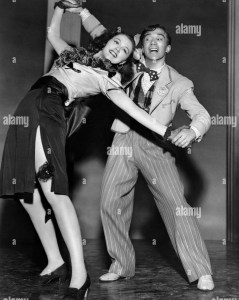
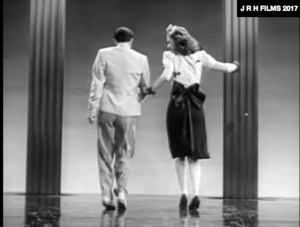
But the opening Lichine-choreographed dance shows us something about Eleanor that’s—new. As Broussard and Royère note, Eleanor, “[d]ancing to boogie-woogie music, and dressed in a tight-fitting skirt and top,…shows a different dance persona from all her previous films.” As staged by Lichine, the dance “mix[es] tap with elements of jitterbug style,” stressing a fast, jazzy rhythm, a loose, free upper torso, and ‘everyday’ movement—such as Lichine’s constant gum-chewing, or Eleanor’s pause to adjust a leg garter, or when Lichine sidles up behind her for a casual embrace. And she engages with a partner, which she rarely did at MGM, and which no doubt accounts, in part, for the relaxed, informal, flirtatious mood. It’s not a grand routine, with a huge corps, an onstage orchestra, and spectacular sets, but instead…an in-the-moment encounter, he ogling, she glancing, the two then slipping into a seemingly impromptu dance.
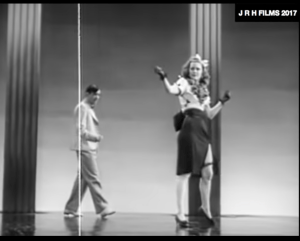
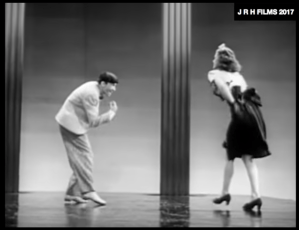
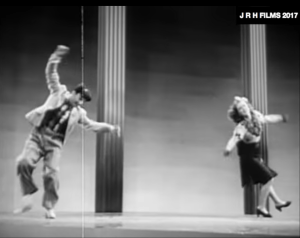
One surprise, for me, here is what a stand-out Lichine is—snapping fingers and gum as he double-pounds his taps, sways hips front and back, slithers up against Eleanor’s backside, or leaps over her crouched finger like a mountain goat over a crag. He’s loose-limbed and swingy, with long, rubbery legs that recall the eccentric dance style of Ray Bolger or Buddy Ebsen. With his baggy zoot-suit-style trousers, his plaid vest and bow tie, and his hair plastered down pudding-bowl style (kind of an Ish Kabibble-era look), his character suggests a backstory, of an Out-Of-Town Hick looking for big-city kicks, and not innocent ones either—which he’s clearly found in Eleanor.
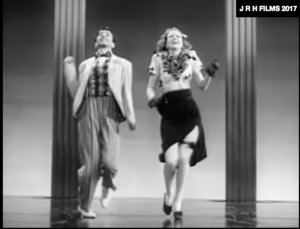
But the number’s biggest surprise is Eleanor. As her biographers note, the dance gives her a distinctly different look—wrapped in her sheath-tight skirt (slit high to reveal plenty of thigh), embellished with a frilly blouse, black gloves, and two big bows (one in her teased hair, another prominent at her lower back), she’s very unlike her fresh-faced MGM image, of cool white dresses or an androgynous tux. Nor does Powell perform any of her typical MGM-style dance moves—no spectacular leg kicks or floor-slapping back bends, nor any of her whip-fast turns en manège or tight, blistering tap solos; nor are there the straight-up torso and fierce, downward pulse of legs and feet. Instead, like Lichine, she’s smooth and sinuous, etching her character in slinking, sliding motions, swinging her hips like a hooch dancer, and waving her arms and snapping her fingers like a long, elegant cobra readying to strike.
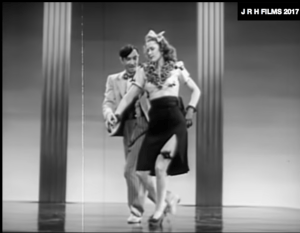
The dance is teasing, insinuating, a sexy, swaggering pas de deux, in which Eleanor engages with Lichine not as a competition (as with Astaire in “Begin the Beguine”), but as a come-on. You’re aware not only of the technical expertise but of the electrical charge between them, their quick, sizzling bodily contact and their skidding, sliding, sensuous step patterns. Powell starts out by snapping fingers and swaying hips, then stops to tweak her garter (plenty of limb exposed) as Lichine takes notice. He leans forward, grins, chews gum, snaps his fingers to catch her attention; she smiles knowingly in response. It’s a pickup scenario, happening on the spot between two interested strangers without any preamble; and the wonder of it is how it got past Hollywood’s Production Code.
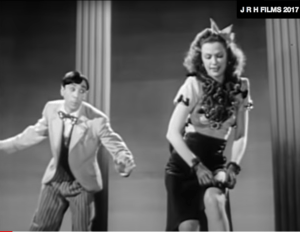
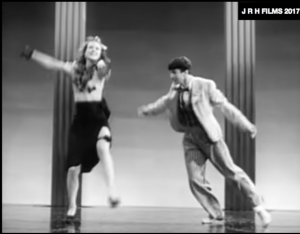
To a jazzy swing piano they start to dance—a slide/walk side by side, hands clapping, arms, knees, and feet twisting and pumping. They circle each other, he pulling her with one hand; then, as she sways in the center, arms ecstatically shooting skyward, he two-foot-hops around her in a squat, head and shoulders thrown back, grinning like a big, happy kid. Pound-pound go their feet; pound-pound goes the piano. When the camera cuts to a long shot, Eleanor falls back, caught by Lichine, then she jumps into his arms; facing him, she grabs his shoulders and lets him sink her to the floor in deep, repeated lunges, the rhythm fast and hard. It’s a stylized seduction done as a flirty dance, she sexy and enticing, he eager and bold; and you’re aware how physically strong and well-matched these two are as they move.
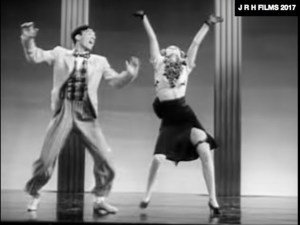
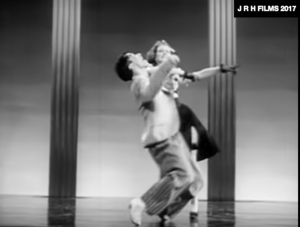
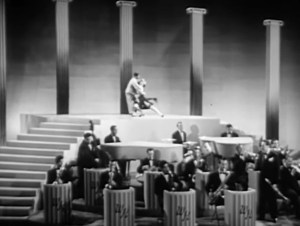
After a cut (to that theater box) we return to the pair spinning rapidly next to each other, tightly pulling in their arms; as they turn, he brings one foot to his knee in turned-in passé, she keeps both near the floor. They again dance side by side, swinging their upper bodies in sync; then she drops to the floor and he leaps over her. Very cute. There follows a great bit where she circle-slides around him while he pistol-taps a foot and swings a snapping hand. His focus is always on her, always responding, rushing in to touch or lead. Then the finish: Facing away from the audience, they dance towards stage back, their hips still swinging, swaying towards each other, the attraction, the sexual crackle between them palpable. Finally, they part, each dancer clapping in rhythm as they disappear from audience view. A sensation, indeed.
The dance is short, fleeting, yet marvelous—fast, sleek, sexy, and a lot of fun; it’s inventive in its intertwining step patterns and catchy in its musical pulse. And the speed, the quick contact between the pair, is more than jazzy dancing; it’s part of the routine’s essence, sparking of its time and place—of 1940s war-time America, when popular entertainment was dominated by jazz-style dance and big-band swing; and also…of a wartime ethos of the swift encounter, the speedy romance. That same year (1944), Jerome Robbins and Leonard Bernstein premiered Fancy Free, presenting, in deft, jazzy episodes, a casual flirtation between two women and three sailors on leave. A year later, the movie The Clock featured a romance between a young soldier on 48-hour leave and a young woman catching a train; in that time space they fall in love, lose each other, then rediscover and marry, before he must return to his unit. Time was no longer a luxury for this era; as the film’s title hints, Life meant grabbing the sensation of the moment. Impulse ruled.
And that oh-so-American impulse in Lichine’s PDD…that also surprises me. Raised in Russia and Europe, his artistic influences were far from American tap-n-jazz shores. Yet his dancing and choreography seen here (and in his other Hollywood films, such as the energetic, neo-classical ballets staged for MGM’s The Unfinished Dance, which I wrote about here) exhibit a remarkable ability to capture (as did the work of another Russian émigré, George Balanchine) the zeitgeist of 1940s America—its headlong, jazzy spirit, its absorption and mixing of popular and classical dance styles. Perhaps it’s no accident that, as his NYT obituary quotes, Lichine first impressed American audiences as “the man who played right end on a college football team.”
But for Eleanor Powell…Sensations of 1945 marked not a renewal but a finish; the movie would be her last starring film role. After withdrawing to private life to raise her son, her final screen appearance would be a dance cameo (below, from the Eleanor Powell: Born to Dance YouTube channel) in MGM’s 1950 musical The Duchess of Idaho (starring the studio’s then-current sensation, swimmer Esther Williams). Eleanor’s solo here was, in a way, a dim throwback to her glory MGM days, featuring, note Broussard and Royère, “her signature tap turns.” It also displayed, albeit briefly, a “new ‘feminine’ style” seen in the dance’s “lyrical ballroom opening.” It might be significant (as well as a bit ominous) that, as she begins dancing in that manner, Eleanor is urged by the film’s co-star, Van Johnson, to “go to work, do something.” She then launches into “a boogie-woogie tap segment… including a mix of rhythms,” accented by her gatling-gun taps, room-spinning chainés, and her hard-driving, close-to-the-floor footwork. Back at MGM, even for a single dance, the MGM Eleanor resurfaced.
Eleanor didn’t dance again until 1959-1960, after her highly regarded children’s TV program, and her marriage, had ended. In preparation for her comeback (done partly out of financial need), she retrained her body by contacting her old partner Lichine for “daily sessions of ballet barre work, which,” per her biographers, “she followed by an intense tap workout, dancing a total of six hours each day.” Although Powell was almost 50, “[t]he athleticism,” notes her Wikipedia profile, “which characterized her dance style remained with her well into middle age,” and she would go on to a successful, if short-lived, nightclub and TV career. Even though, by the early 1960s, tap was considered dead, Eleanor, per Broussard and Royère, was “one of the few dancers from the golden era of Hollywood still performing [it]….it had almost become a lost art, and [Eleanor] felt the time was ripe to champion a revival.” As Van Johnson had urged—Eleanor got to work.
Today, Eleanor Powell is still perceived, per the title bestowed on her by the Dance Masters of America, as the World’s Greatest Tap Dancer—Hollywood’s tapping dynamo, pounding out syncopated rhythms via feet, ankles, and specialty shoes. But it should be noted, Eleanor also expanded the tap form—combining in it gymnastics, ballet (reflections of her earliest training), and elements of jazz, as well as adding a special kind of feminine pizzazz—showing how strong and varied, and, yes (despite Van Johnson), even lyrical tap could be.
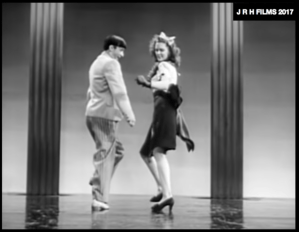
And, as Eleanor showed in her Lichine PDD, she could push tap further, beyond her wonted technical dazzle or demure image (or even Freed’s dismissal)—bringing to it a fluid, expressive torso as well as a sensual charge. Her dancing here displays her body not just as a trained, technical instrument but as physical metaphor—of desire, provocation, erotic impulse, with an expressive meaning. It’s dancing that embraces a kinesthetics beyond mechanical prowess, as well as an aesthetic that suggests, even embodies, a significance beyond the steps themselves.
Such a kinesthetic expressiveness was later realized in the full-bodied sensuality of Cyd Charisse—who, like Eleanor, was classically trained. and artistically and technically splendid (and whose film career was also largely at MGM), but who, as a dancer, never tapped a step. Curiously, Charisse was a Lichine discovery, he selecting her to partner him in an adagio number in her 1943 film debut (under the name Lily Norwood), Something to Shout About (they would work again in The Unfinished Dance). Could Lichine have seen, or brought out, a similar quality within Powell? Or did Eleanor work into it herself when working with him? (And it was Lichine she asked to help her retrain for her comeback.)
Charisse’s own dancing, writes Dan Callahan, brought out “something jazzy, something modern” (it was, he muses, “ineffable, indescribable”); and it’s her jazzy, if classically inflected, movement style that prevailed in Hollywood musicals throughout the 1950s. Whereas tap, if onscreen at all, was presented as a curiosity, a Marker of a Past Era. You might ask: Did Eleanor’s focus on tap dance limit her? Did it confine her to a visually stunning but expressively restricted dance form? Is tap even, as Callahan writes, “slightly klunky” in its kinesthetic effect?
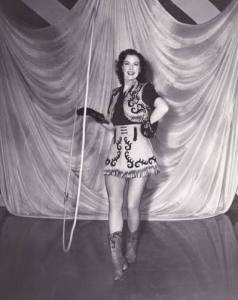
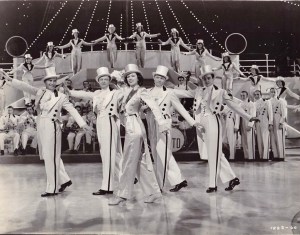
Eleanor’s old studio, MGM, had pigeon-holed her as a solo Tapping Sensation (and then, by pairing her onscreen with the goofy, inapposite Skelton, maybe even sabotaging her career); often isolating her in novelty numbers (hulas, lassoes) or within mammoth sets (battle ships!), glitzy costumes, and casts of thousands; exploiting her physical prowess but missing out on a more intimate, emotional dance expression. When she returned to the studio for that Duchess solo, it was also a one-off—MGM bunging her in, perhaps as a sentimental gesture, a backward look at old times. After her 1960s comeback tour, Eleanor settled into graceful retirement, her memory, image, and prodigious talent also a subject for sentiment—preserved in TCM move reruns and academic articles on terpsichorean cinema; set aside like a burnished heirloom…like tap dancing, or like the movie musical itself.
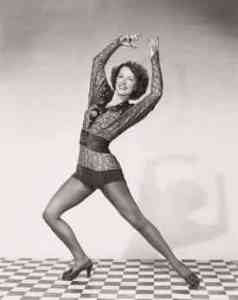
But it’s here, in a barely known PDD in a cheap little independent flick, dressed in a cheap little skirt which makes her into a cheap little chippie, that Eleanor looks—and dances—like a million bucks. I wish Eleanor could have continued down this route in films—expanding her range, extending her expression, always trying something—new. Who knows what other sensation might have emerged in her dance.
For the curious, click here to watch a complete print of Sensations of 1945 (its re-issue title was just Sensations). The Powell-Lichine dance appears right at the start. The film is also noted for being W.C. Fields’s last movie (he would die a year later). His appearance here is not prime Fields: His comic routine (set on a train) is bad, sad, and just plain unfunny; and Fields looks ill and distracted. It’s really for diehard Fields completists only. (I’m one, so I watched it, but I wouldn’t care to see it again…)

